
Regulatory compliance is a given in every work zone. Signs must be placed correctly. Cones and other traffic control devices must meet established standards. Crews must follow approved plans and procedures. Meeting these requirements is nonnegotiable. However, true safety leadership cannot end there.
While regulatory guidelines matter, and meeting the standard is essential, active work zones do not always unfold exactly as they appear on paper. Traffic patterns shift. Motorists respond unpredictably. Weather, visibility, and the progress of the work can introduce new risks. This is why true safety leadership means continuing to observe, evaluate, and improve.
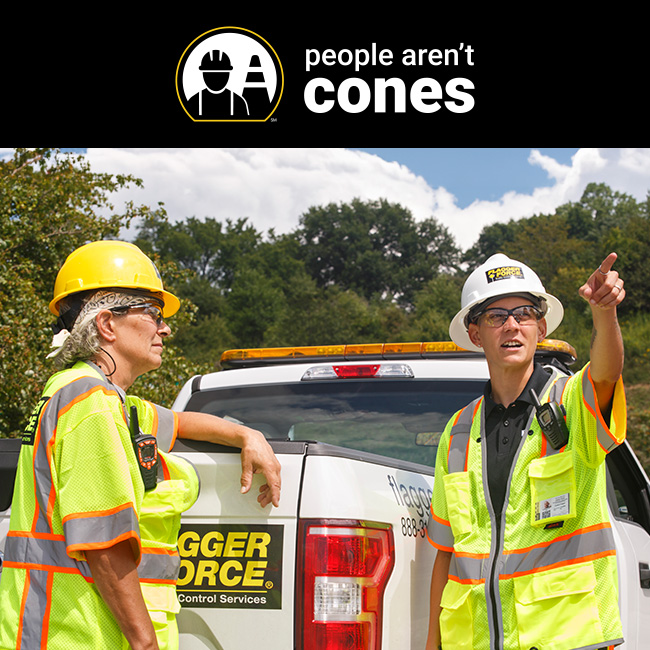
At Flagger Force, that responsibility is rooted in the belief behind our People Aren’t Cones℠ campaign: compliance is the baseline, not the finish line. The people working just feet from live traffic deserve more than a checked box. They deserve an organization that continually asks whether more can reasonably be done to help protect them, as well as everyone sharing the road.
Compliance Defines the Standard, Not Every Exposure
The Federal Highway Administration’s Manual on Uniform Traffic Control Devices (MUTCD) and state-specific traffic control typicals (standard diagrams illustrating how particular work zones should be configured) provide a picture of what a compliant short-term work zone should look like. However, they cannot account for every exposure involved in setting up, maintaining, and removing one. “Regulatory requirements tell us what things must look like when we’re done working, but they don’t necessarily tell us how we get there,” explained Luke Lazar, Vice President of Risk & Safety at Flagger Force.
Set-up and tear-down are prime examples. During these phases, traffic control professionals may be working in high-exposure areas while the work zone is still taking shape or being removed. Addressing these risks requires leaders to look beyond the final configuration and consider how each stage of the work can be performed as safely as possible.
Going beyond compliance begins with identifying the exposures that carry the greatest potential for a severe incident, developing ways to mitigate them, and working systematically through other foreseeable risks. It also means learning from field observations and near-miss incidents before an injury (or worse) occurs.
The Traffic Tells You
Standards establish consistency, but motorists’ actions cannot be fully predicted. That is why observation and human judgment remain essential in work zones.
Luke shared a saying in short-term traffic control: “The traffic will tell you” whether a work zone is operating as intended. Motorists may stop where they should not, merge at the last moment, or show visible confusion. These behaviors can signal that an adjustment is needed, even when the work zone is fully compliant.
Luke recently observed exactly that situation at a work zone with a compliant shifting pattern. As the team watched traffic move through the area, they noticed that some motorists appeared confused about the intended path of travel. Although the set-up met applicable requirements, the team recognized that drivers needed a clearer visual cue. They added three cones to better define the shifting pattern, and traffic flowed much more smoothly afterward.
The change was minor, but the thinking behind it is significant. The team did not assume that their responsibility ended because the set-up met requirements. They watched how the work zone functioned, recognized an opportunity to make it clearer, and acted.
Turning Field Observations Into Broader Improvements
Conditions may also change throughout the workday as traffic volumes fluctuate, weather shifts, or a client’s work progresses. Flagger Force team members must identify potential adjustments during the pre-job brief, while discussing the Job Safety Analysis, during set-up or tear-down, and as the day unfolds. They can then document and elevate those observations for supervisory oversight.
When a field lesson has broader relevance, it can become part of organization-wide training. For example, after Flagger Force identified an increase of reports involving slips and falls, the company incorporated changes into its training and issued mandatory microlearning focused on the hazard.
This process turns individual observations into collective knowledge that can benefit teams across different locations. Safety leadership is not a one-time achievement. It is a continuous-improvement process built through thoughtful, incremental changes and the willingness to keep asking, “How could we make this better?”
Safety Leadership Belongs to Everyone
That question of always improving cannot belong to one department alone. Flagger Force’s Risk & Safety team provides expertise, standards, training, and oversight, but leaders across the organization share responsibility for how those standards are executed.
“The decisions we make across the organization ultimately affect the people working in and around our work zones,” said Mike Doner, Flagger Force President and CEO. “That includes how we train and prepare employees, how Field Operations supports crews, how we equip our people, how we communicate with clients, and how we respond when something in the field tells us there may be a better or safer way to perform the work.”
This shared accountability also strengthens operations. A prepared crew, a work zone motorists can clearly understand, strong client communication, and employees who can respond to changing conditions contribute to safer, more consistent, and more reliable work.
People Deserve More Than the Minimum
Our People Aren’t Cones℠ campaign is about more than the colors that help distinguish traffic control professionals from the equipment around them. It underscores a more fundamental truth: The people working in and around work zones are not simply part of the environment. They are individuals we all share a responsibility to protect.
Flagger Force team members wear high-visibility yellow, full-body personal protective equipment with retroreflective material so the human figure stands out and motorists can look to that person for direction. But making people visible is only part of protecting them. It also requires an organization willing to listen to what employees are seeing, learn from field experience, and act when there is a better way to protect workers, clients, motorists, and community members.
The people working in and around work zones deserve more than the minimum level of protection. At Flagger Force, being Safety-Driven® means recognizing that compliance is where our responsibility begins. We continually do the work required to move safety forward at every step. “Safety and operational performance are not competing priorities,” Mike emphasized. “When safety is built into how you operate, it strengthens the entire operation.”